Saturday, March 29, 2014

I'm With the Florida Craft Brewers!

Big happenings in the Sunshine State
What the heck is going on with the Florida craft beer industry?

Tons, actually. Florida, which not that long ago was a bit of a craft beer no-man’s-land, has undergone a renaissance over the past 10 years. Breweries are popping up all over the state and big markets like Tampa have become beer towns, with craft beer scenes that rival some of the best in the country.

But this new found resurgence is not without its challenges, most of which are coming from big beer and the state government.

There has been a struggle between Florida brewers and the state for a while now, mostly over growlers. The laws on the books in Florida make 64oz growlers illegal, which as we all know, is the standard size of a growler. There are ways around this, of course, but needless to say, brewers in Florida have been asking their government to amend the growler restrictions, and understandably so.

This argument over growlers has opened up a Pandora’s Box of sorts and now, as of March 22nd, a total of 11 beverage industry bills are up for consideration in the Florida Legislature, according to BrewersLaw.com. All but a handful of those bills are focused on dramatically reshaping the operation of Florida’s breweries. But three, in particular, are causing a stir.

Not an actual representation of debating Legislators
House Bill 387 has been unanimously approved by the Florida House Regulatory Affairs Committee, and authorizes beer tastings at licensed premises. It amazes me that they weren’t authorized before, but hey – good news story.

House Bill 1329, on the other hand, is under attack – and that is a very good thing. Dubbed the “Big Beer Bill,” HB 1329 limits the sale of beer from the brewer to the end consumer, requires brewers to include intent to supply beer to distributors in their business plan, prohibits tap rooms from selling beers brewed wholly or partially by another brewery, and defines a growler as 32 or 64 ounces. Not surprisingly, this bill has the support of a group of Anheuser-Busch distributors in Florida, and rumor has it that they may have been involved in the bill’s inception.

The good news is the House Business and Professional Regulation Subcommittee filed an unfavorable Staff Analysis on March 21st, stating that the “restrictions and limitations [contained in HB 1329] should reduce the potential revenue of [Florida craft breweries].” Also on March 21st, two “strike all” amendments were filed in the House to entirely re-write the text of HB 1329.

Florida needs growlers, just like growlers need Florida
Meanwhile, in the Senate, there is Senate Bill 7120, which was introduced on March 21st. It essentially matches the growler-focused portions of HB 1329, limiting a brewery’s off premises consumption to filling 32 and 64 ounce growlers with only the brewery’s own beer. The Florida Brewers Guild has written the below letter regarding the impact of SB 7120, which was forwarded on from Charlie Papazian, the President of the Brewers Association:


The Florida Brewers Guild needs your help to oppose legislation that is severely detrimental to Florida’s breweries. It is imperative that you contact the Senate President and your local State Senator as soon as possible to tell them to VOTE NO on Proposed Senate Bill 7120.

Although the Proposed Senate Bill 7120 will legalize 64 ounce growlers, it places burdensome and punitive restrictions on breweries and their tasting rooms that are not in place under current law and serve no other purpose than to strongly curtail the rapid growth of small business breweries in Florida.

The bills will make it illegal for breweries to sell a 128 ounce growler. It will make it illegal for breweries to fill growlers of their own beer if it was brewed at another location. It will make it illegal for specialty beer shops that are subject to inspection by the Health Department to sell growlers but protects liquor stores that are not required to be inspected by the Health Department. The bill also stipulates that if the new growler restrictions are not strictly adhered to, then you are committing a first degree misdemeanor and could have your brewery license revoked.

Additionally, the bill makes it illegal for breweries to sell beer in bottles and cans for off-premise consumption, including collaboration beers, and makes it illegal for a brewery to make cider or mead.

Tap rooms are magical places
Even more alarming, it kills any potential for creativity and future growth in the industry, as it contains an oppressive limitation which states, “anything not specifically authorized . . . is prohibited unless otherwise authorized under the Beverage Law.”

The bill does offer an advantage for beer distributors, granting them an exemption from the current law that requires any beer picked up by a distributor from a brewery be brought back to their licensed and bonded warehouse to ensure compliance with state and federal taxation.

Simply put, these anti-consumer, anti-business restrictions will hurt Florida breweries and put an end to the growth of craft beer along with many of the jobs created by the brewing industry in Florida.

It is imperative that you contact the Senate President and your local State Senator to tell them to VOTE NO on this bill. Tell them how harmful these restrictions will be to your local craft brewery. Please be courteous and respectful, but let them know that you care about Florida’s craft breweries and their positive economic impact and job growth they bring to your local community.

Thank you for supporting craft beer in Florida!


I'm tired of keeping calm!
If you want more information about these legislative debates, BrewersLaw.com has a good summary and links to more sources. I highly recommend them as a starting point for your research.

It will be interesting to see how this all shakes out. Perhaps the favorable decisions that were made in the House will also be made in the Senate. Or, perhaps the big beer and distributors lobbies will successfully destroy the brewing industry in the state of Florida forever. I’m rooting for the former, obviously, and I encourage all of you to spread the word about this nonsense and raise awareness about it. Even if you don’t live in Florida, as I do not, this effects craft beer lovers everywhere. If these types of shenanigans are successful in the sunshine state, they could try them in your neck of the woods too. And if you do live in Florida, please contact your representatives and senators to petition them to support delicious craft beer in your state.

Here’s to craft-brewed happiness… Cheers!

Saturday, March 22, 2014

Beer-Related Madness, in March

Standard Issue Tuna Melt - Delicious!
March Madness is once again upon us. The annual college basketball tournament (or tuna melt as I've heard it called… interesting…) is in full swing and the favorites are dropping like flies. Meanwhile, at a local newspaper or national news agency near you, a different sort of bracketology is going on – craft beer bracketology.

It’s exactly what it sounds like. These media folks are pitting craft beers against each other in a March Madness-style tournament of sorts. Most focus on local beers from around your neck of the woods and enlist local people to vote for their favorites. The folks who vote are sometimes a panel of supposed experts, but usually a collection of ordinary people who drink beer. I've seen the more high-speed news outlets have online voting.

On one hand, this is probably a genius marketing ploy by the brewing industry as it raises awareness of local craft beer and gets people who wouldn't otherwise care about craft beer to suddenly care. I guess. It’s interesting, and it appeals to people’s local pride, sense of competition, and love for college basketball and beer. Sounds like an “everybody wins” kind of situation, right? Right?

Actually, I’m not convinced.

If you really drink craft beer, and I mean really drink craft beer - are borderline obsessed like I am, don’t read these “craft beer brackets” stories. Don’t be fooled. They’re not meant for us. They’ll just make us angry.

Here’s why.

A great beer
First of all, whenever you enlist public voting for a supposed competition, that competition will inevitably become nothing more than a popularity contest. We see this play out in the MLB All Star Game Fan Vote, which votes Derek Jeter to be the starting short stop for the American League every year, even though he hasn't been the best short stop in the American League in 4 years. But he’s a living legend, future first-ballot hall of fame player and people know him.

This is already happening in the Washington Post’s Beer Madness for 2014, which fills out its bracket with beers from all over the DC, Virginia, Maryland, Pennsylvania and Delaware region. In the first round, Dogfish Head’s 60 minute IPA is up against Mad Fox Brewing Company’s Orange Whip IPA. For those of us who live here, and are dedicated beer people, this is a no-brainer – Orange Whip is vastly superior to 60 minute in every way. It shouldn't even be close. Except that Mad Fox is not as known as Dogfish and many people involved in this fan vote have never heard of them, let alone had the Orange Whip. As a result, Dogfish Head’s 60 minute slaughtered Orange Whip in the first round… a travesty.

An even better beer
And of course Dogfish has their legions of fan boys who would vote for anything Sam Calgione churned out – this is my second point. These brackets feature small breweries and big breweries (not big beer) alike, and when you factor in brand recognition, popularity and customer loyalty into the equation, the little guys don’t really stand a chance. Now don’t get me wrong – I happen to like Dogfish Head beers, but I am not a true believer who will blindly vote for them because I saw the shark on the bottle.

Another problem, and my third point, is that while there is an effort to include smaller breweries in the tournament, even though they don’t really stand a chance anyways, the larger breweries often have multiple beers in the brackets - because apparently, there aren't enough breweries around to have all single entry. Hogwash. Maybe not all regions of the country have enough breweries to fill out a 64 beer bracket, but in the case of the WaPo Beer Madness Bracket, which has cobbled together entries from at least five states, they could have easily found 64 unique breweries.

Actual beer competion
There is also an attempt to categorize the beers into four types (regions) so as to not compare apples to oranges. I think I understand the intent behind this, but if the final four is comprised of the winners from the four categories, eventually you will have to compare apples to oranges. Maybe it’s that they don’t want to have four IPAs in the final four, which likely would happen. This is exactly the reason why actual beer competitions only compare beers of like styles against each other, and have multiple gold medal winners. This being a marketing engine, what difference does it make?

So because of popularity, a lack of options and low-information in the minds of the voters, you’re going to be left with a final four consisting of a Dogfish Head, a Tröegs, a Heavy Seas and a Starr Hill – all of these breweries make great beer, and their brewers are great Americans, but what about the little breweries?

Get out and vote!
Now as I alluded to at the top, this doesn't mean the brackets don’t have their place… they’re probably a powerful marketing tool – they have to be. A few years ago, one media outlet had the idea to team up with local brewers and now… we have at least 10 different brackets in the DC Metro Area featuring our local beers. So obviously it makes money for those involved. As an advocate for delicious craft beer in spite of who makes it, what I am saying is if you’re like me, you may want to skip these brackets… you most likely won’t like what you read. Or, you can organize a coalition of like-minded craft beer hunters to go online and rock the vote, and make sure that justice is done. Just as long as you’re prepared to invest quite a bit of time and effort into your cause… the legions of Dogfish fan boys are not easily thwarted.

Here’s to craft-brewed happiness… Cheers!

Saturday, March 15, 2014

Beware the Ides of March

The Dude abides
First of all, I know that Monday is St. Patrick’s Day, but I will not be writing about any Irish snake whisperers today. I know many of you associate beer to St. Patty’s, and rightly so, but I plucked that low hanging fruit last year, so in order to at least appear as though I have some method to my madness, as opposed to this all being a collection of random strands in ole’ Duder’s head, I am going after an alternative target. If you simply must get your St. Patrick’s Day beer blog fix, here are some links to posts I wrote on Irish Beer and St. Patty’s and Irish Red Ales. Sláinte!

Also, since I currently find myself in administrivia mode, and by way of an apology, I’m sure many of you logged on to your computers and mobile devices last Saturday, hoping to sit down and read the latest inspiration, only to find there was none. Sometimes life gets too hectic, and even the most stalwart advocate for truth and beer can’t make a deadline. That being said, my personal hang-ups do not concern you, nor do they excuse my lack of a blog post, so for that, I apologize to you all. With any luck, I will make it up to you – maybe not today, but eventually. Then again, maybe not.

And away we go.

Et tu, Brute?
The Ides of March, or Idus Martii/Idus Martiae on the ancient Roman calendar, corresponds to March 15 and was the day that Julius Caesar was stabbed 23 times by his Senators and friends, according to Bill Shakespeare. In fact, in that Shakespeare play, Caesar was warned by a soothsayer to “beware the Ides of March,” as something terrible was going to happen.

Today, the date is fairly innocuous, however mid-March (we can call it the Ides of March) is when many people start thinking about spring (read spring beer styles). I know the folks up at the Boston Beer Company release their Sam Adams Spring Variety Pack in early January for some reason, and many people have unrealistic expectations about winter weather being finished by mid-February, but I think mid-March (the Ides) is an honest time to make the transition from winter to spring – in all aspects of life – not the least of which is beer.

So how do we do that? Or more accurately, what can we expect to see in our beer glasses now that spring has sprung?

There really isn’t a specific style of beer associated with the spring season. Not in the same way that autumn is linked to Oktoberfest märzens and pumpkin ales, or winter is linked to Christmas ales and winter warmers. Even summer has any style that is light, crisp and refreshing, like kholsch, saison, hefeweisen, witbier, etc. Spring kind of gets hosed. Or does it?

Not only is spring and the month of May part of the maibock tradition, it also involves goats. Crazy Euros.

A little known beer style to season connection with spring is the helles bock or maibock. Maibocks tend to be lighter in color than other bock beers and often have a significant hop character with a noticeable alcohol around the same as a traditional bock. Color can range from deep gold to light amber with a large, creamy, persistent white head, and moderate to moderately high carbonation, while alcohol content ranges from 6.3% to 7.4% by volume. The flavor is typically less malty than a traditional bock, and may be drier, hoppier, and more bitter, but still with a relatively low hop flavor, with a mild spicy or peppery quality from the hops, increased carbonation and alcohol content. Maibocks are customarily served in the spring and are oftentimes interrelated with spring festivals and celebrations in the month of May. Dead Guy Ale from Rogue Brewery in Oregon is a fine example of the style.

Sláinte!
Unfortunately, maibock is the only style that spring can claim for itself, so we are forced to get creative. Technically speaking (writing/reading), if we are to use the Ides of March as the cutoff for spring beers, and since St. Patrick’s Day falls on March 17, you could make the argument to include the Irish red ales and dry Irish stouts to our list of spring beers. Just as long as you don’t try to include any yellow fizzy industrial swill beer with green food coloring. No dice, Budweiser.

We can also attempt to invoke spring-like themes and seasonal transition motifs in our styles. For example, if winter beers are dark, and summer beers are light, than somewhere in between might make for a good spring beer – something in the red/amber color category perhaps. Meanwhile, spring usually equates to freshness, and freshness in beer is generally done with hops. Hops, needless to say, make us think of IPAs. Not to mention that IPAs are usually golden to amber colored, so they pass the arbitrary appearance test to be considered a spring beer.

But then again, IPAs should be enjoyed all year round, so we should already be enjoying them in the spring, thus making this line of opining moo – it’s a cow’s opinion. It doesn’t matter.

It's moo!

I suppose, in the end, the absence of a defined style for the season makes for abundant possibilities, which are the spice of life (is that right?). The more possibilities a brewer has, the more variety will appear in the final product, and the more opportunities for enjoyment by you – the consumer. Sounds like everyone wins to me.

Beware the Ides of March? More like rejoice in the Ides of March!!!

Spring has sprung… now let’s go drink some beer!

***UPDATE*** I just remembered that variety, not abundant possibilities, is the spice of life. Though that sounds like six of one.

Here’s to craft-brewed happiness… Cheers!

Friday, February 28, 2014

An IPA by Any Other Name...

Strength and honor.
…if you find yourself alone, riding in green fields with the sun on your face, and you’re reading an inspiration from inside of a mash tun on a Friday instead of a Saturday, do not be troubled. For you are in Elysium.  And you’re already dead!

Other than that, I have no explanation as to why this week’s blog post is coming to you on Friday instead of Saturday. Or do I? [cue sinister music]

Okay, seriously though, last week, I unintentionally left many of you faithful readers (and myself to be perfectly honest) on a delightful cliffhanger, head-scratcher, nail-biter, non-deliberate foreshadowing moment when I started babbling about possibilities - specifically as it pertained to the Red IPA idea. Many of you have approached me in the aftermath wanting to talk about Red IPA, Black IPA, White IPA, and all the other variants of everyone’s favorite style of craft beer – the India Pale Ale. Hopheads rejoice – I am right there with you.

Hops, ah, they'll save everyone of us
The IPA is one of the most manipulated styles of beer, mostly because brewers are naturally creative people (why thank you) and everyone loves hops. But even with all this innovation, the Brewers Association style guidelines only recognize three official categories of IPA (four if you include the American black ale, often referred to as a black IPA):

- English-style India pale ale
- American-style India pale ale
- Imperial (double) India pale ale

Although those are the only styles of IPA that are defined and judged, the spectrum of IPA sub-categories is not limited to three. Essentially, outside of changing its color, there are two ways that brewers manipulate the style:

1.      Take an IPA base recipe and ferment it with an atypical yeast strand
2.      Take a different style of beer and hop it as if it were an IPA.

In this edition of the mash tun, I will attempt to name, describe, and categorize some of the not-yet defined sub-categories of IPA emerging in the marketplace. This list is not sanctioned by anyone, and it is not designed to be comprehensive. PS – Somewhere, Dr. Ian Malcolm is going berserk.

God help us, we're in the hands of engineers

Belgian-style IPA

A Belgian-style IPA, also known as a Belgo-IPA, is an IPA base recipe fermented with Belgian yeast. It has a similar appearance, malt content, hop aroma and flavor profile as an IPA, but with the noticeable fruity esters and flavor characteristics of Belgian yeast.

India Session Ale

India Session Ales, also known as lawnmower IPAs, provide all of the hop goodness of an IPA, but at a more sessionable ABV level. Sessionable just means one can drink more of them in one session (due to lower ABV) without being bombed out in the process.

No, they don't come from white hops
White IPA

This one often gets confused with Belgian-style IPA, and for good reason. The only difference between the two is that a White IPA is specifically a Belgian witbier hopped like an IPA. You may ask why make this distinction – and the answer is as always because this is my blog and I do what I want. A White IPA has similar color, body and esters as a witbier with noticeable hop aroma, flavor and bitterness.

Brettanomyces/Wild IPA

Now we’re going full on grizzly bear mode. This sub-style IPA is an IPA or IPA sub-category that goes through primary, secondary or other fermentation with wild yeast. This one requires some serious brewers with serious issues in order to dream up. Science, yo!

Red IPA

Red IPA, like I described last week, is an American red ale brewed at a higher strength and hopped like an IPA. They are typically redder in color than an IPA with deep ruby hues.

Rye IPA

A Rye IPA (or RIPA) is an IPA brewed with the addition of rye as an ingredient. They are generally tangier than ordinary.

Spiced/ Herbed IPA

These IPAs are brewed with the addition of spices, herbs or flowers. When properly balanced across the flavor profile, they can do amazing things to your palate.

Only some of the awesomeness you'll find in a black IPA
Black IPA

The black IPA is one of the most discussed beer sub-categories in the beer world. Technically, the style has already been named and defined by the Brewers Association as the American-style black ale. It is essentially an IPA brewed with the addition of dark specialty malts, resulting in a dark brown to black colored IPA with a hint of roasted malt flavor.

Clearly, brewers are experimenting with IPAs, as this list indicates. The reality is, this is not an all-inclusive list, and the potential for sub-categories of sub-categories becomes exponential when these styles are combined. As more and more brewers step outside of the traditional style guidelines, expect to see more variations of the IPA style to appear near you, wherever fine craft beers are sold. You think you’re excited? You have no idea.

Here’s to craft-brewed happiness… Cheers!

Saturday, February 22, 2014

Amber Waves of Red

Beautiful, isn't it?
It’s been a while since my last post on style, so I think it’s high time I broke another one down for you. And since February is in the home stretch, and March is generally associated with Ireland, it’s only fitting that I discuss one of the styles usually allied with March and Ireland – the red ale.

For most, the term “red ale” immediately stirs towards George Killian’s Irish Red Ale, which is actually an amber lager by style, and ever since selling out to Pete Coors, has significantly spiraled down a path towards “not good.” Simply put, the style “red ale” is a catch-all for any beer that is lighter in color than a dark ale, ranging from amber to deep red hues. The flavor and aroma tend to focus on malt character as opposed to hop character, however it is not unheard of for a “red ale” to be significantly hoppy. “Red ales” are typically well-balanced with toasted malt features and light fruitiness notes.

In other words, “red ale” is a fringe style that has very little in the way of guidelines, meaning that it has endless possibilities for brewers, and in turn, endless possibilities for drinkers. Even the highly touted Great American Beer Festival (think the Oscar Awards for beer) doesn't have a specific style for “red ales,” fitting them neatly into the wide-ranging “American amber/red ale” category. It’s another clear example of definition by elimination, but like I said… endless possibilities.

So let’s look at a few. As I intimated in the opening verse, “red ales” are traditionally linked to Ireland, and are often called an “Irish Red Ale.” Unfortunately, there’s not a whole lot to say with the history of “Irish Red Ale.” It originated in the town of Kilnenny, in 1710, and was pretty similar to an English Pale Ale, the only difference being a bit of roasted barley added to the grist. This gave the beer a darker, red color and added a toasty, dry flavor, making it very smooth and highly drinkable. A very good example of an Irish red ale is Smithwicks.

Kilkenny Castle, Republic of Ireland
Interestingly, it’s not a style that has a huge following in its native homeland, being dwarfed by other Irish styles like dry stout and lager. “Red ales” are much more popular here in the U.S. due to the relentless marketing of Killian’s (which is actually an Amber Lager, and a shell of what it used to taste like). Back when Killian’s rose in prominence, red beers were all the rage in America, and all of them were actually Amber Lagers and did not fall under the category of what true Irish Red Ale is supposed to taste like.

True to style - pretty good
Of course, like it always does, the craft-brewing community came to the rescue, and began brewing proper (and accurate) Irish red ales. Beers like Harpoon Brewery’s Celtic Ale from Boston and Great Lakes Brewing Company’s Conway’s Irish Ale from Cleveland are perfect examples of what I’m talking about. In fact, recently, I got a hold of a bomber of Fred Red by the Blue & Gray Brewery from Fredericksburg, VA that also exemplified a perfect representation of what an “Irish red ale” is supposed to be. Fred Red had a robust malty base balanced with selective European hops for a fresh, bold finish. Nothing over the top, just a quality, well put together, Irish-style red ale.

In a word, scrumtrulescent
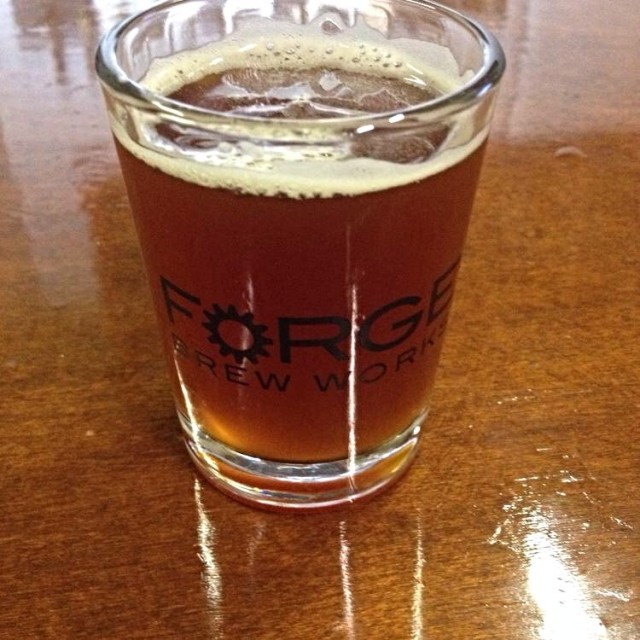
But as I also said earlier (I love referencing myself when making a point), American red ale is all over the place in its non-definition, creating all of those lovely little possibilities and opportunities I mentioned. Out on the left coast, beers like Port Brewing’s Shark Attack Double Red Ale from San Diego, Speakeasy Brewing’s Prohibition Ale from San Francisco and Bear Republic’s Red Rocket Ale from north of San Francisco are perfect examples of what American ingenuity brings to a beer style. By way of example, yesterday, I got into a pint of Forge Brew Works’ Martin’s Bane Imperial Red Ale from Lorton, VA. Martin’s Bane was phenomenal – well balanced between malt and hops, while keeping enough hoppiness around to satisfy the hop head. It was very smooth for an imperial, hitting north of 8% ABV, and there was little to no alcohol heat. The beer poured a gorgeous red-hued amber color with white head. Literally, everything you want – nothing you don’t.

But doubling up the malt and hops into imperial mode is only one variation on “red ales” that the Americans are brewing up these days. I've also started seeing a style that the folks are referring to as Red IPA surfacing and spreading like wildfire. The Red IPA is essentially a red ale that is aggressively hopped like an IPA. Sounds delicious, right? In this same spirit, a brewer could easily play around with all of the aspects of the red ale and make new beers that are really cool. For example, replace the yeast in the red with a Belgian yeast, and now you've got a Belgian Red Ale. Then, use that same yeast but add the hops from your Red IPA, and now you've got a Belgian Red IPA. What if we added Raspberries into the boil (or fermentation)? Now it’s a Red Framboise IPA. Endless possibilities.


What kind of super plant is this? Raspberries and hops together? Madness!

So if you observe the Irish festivities in March, and you find yourself drinking beer, look for a red ale, and try to find one that is actually a red ale. And look for ones that are Irish (Smithwicks or O’Hara’s). And look for ones that offer endless possibilities. That’s the American way.

Here’s to craft-brewed happiness… Cheers!

Saturday, February 15, 2014

Ale to the Chiefs

Looks like a good time to me

Monday is President’s Day, a day that is intended (I think) to celebrate the lives and accomplishments of all of our Commanders in Chief, but usually revolves around only two – George Washington and Abraham Lincoln. I’m not entirely certain if this is by design or merely because the national holiday falls between their respective birthdays, but regardless, George and Abe are the two Presidents that seem to get all the glory this time of year. They both have pretty respectable resumes to be sure, but where did they fall on beer?

I think this one is Photoshopped
It is widely reported that George Washington loved beer. He was said to drink porter by choice, however he famously boycotted his beloved imported British porters just before war broke out and lent his support to a bill that called for the avoidance of British beer, tea and other cornerstones of daily life (the bill in question was crafted by one Samuel Adams).

George was also a home brewer, though his wife and servants most likely did most of the brewing. The recipe for his “small beer” – an everyday drink that might be consumed by children, servants and the infirm – can be found at the New York Public Library today. If brewed strictly to his methods, this beer would clock in around the 11% ABV mark, with the addition of ample amounts of molasses as the main culprit.

General Washington was also known to hold meetings with foreign heads of state and his own cabinet members and military officials in pubs and taverns. In fact, his headquarters when he was in New York City was an inn kept by Samuel Fraunces, whom he later appointed his household steward when he was elected President.

The famous "and beer" quote
Abraham Lincoln, on the other hand, most likely did not drink beer. In fact, it is reported that he did not drink at all. Even though he is credited with one of the famous beer quotes, “I am a firm believer in the people. If given the truth, they can be depended upon to meet any national crisis. The great point is to bring them the real facts, and beer.” Some historians are convinced that the “and beer” part of that quote was a turn of phrase from a master orator, and not a sign of Lincoln’s beer drinking habits. Other historians will tell you that the “and beer” part was added later and was never actually said. There is one account in which one of Lincoln’s friends described him drinking lager while trying to recover from an illness, but other than that, there are no historical indications that Abe ever drank beer.

What about other Commanders in Chief? What are their contributions to our beloved beer culture?

Thomas Jefferson was a home brewer, just like George Washington and many other founding fathers. He considered beer a “table liquor” and served it regularly at meals in Monticello.  In his later years, Jefferson became obsessed with the science and overall process of brewing beer, constructing a state of the art brew house on his grounds to experiment with.

Fires me up!
James Madison, the father of the constitution, seriously considered proposing a national government-run brewery, even though he was a noted proponent of small government during much of his political career. He also wanted to establish a secretary of beer for the cabinet. He was motivated by establishing beer making as a viable component of the fledgling economy. As a member of the House, Madison encouraged “the manufacture of beer in every State in the Union,” part of his justification for proposing to levy taxes on barrels of ale and spirits (most of which were being imported from England and elsewhere).

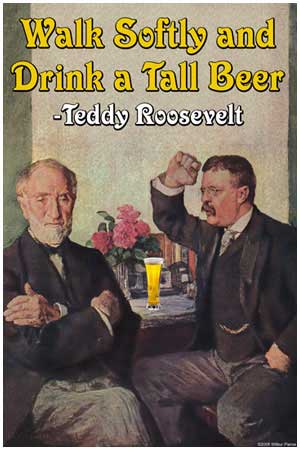
Teddy Roosevelt, according to legend, brought 500 gallons of beer with him on an extended African safari. That’s a lot of beer.

Franklin Delano Roosevelt presided over three pieces of legislation that positively affected us modern day beer people. On March 22, 1933, he signed into law the Cullen-Harrison Act, which legalized the sale of beverages containing up to 3.2% ABV, as well as the Beer and Wine Revenue Act, which gave the states the power to regulate their own sales and distribution of beer, wine and spirits. Shortly after that, in December 1933, congress repealed prohibition.

Jimmy Carter signed a bill in 1978 that made it legal to home brew, which was illegal up to that point as a holdover from prohibition. He also signed a separate act which eliminated most taxes on home brewed beer and wine. Of course, Jimmy’s brother Billy had his own line of beer.

Beers for everyone!
Ronald Reagan used a quick trip to a Boston-area pub in 1983 to re-connect with voters, when he sat down and had a beer with a few Democrats at the Eire Pub. The Ronald Reagan Presidential Library has a replica beer pub based on the one he patronized during a presidential trip to Ireland.

George W. Bush received a boost in the 2004 campaign when it was determined that most Americans would rather have a beer with him than with his opponent John Kerry. This set a new precedent that future presidential candidates would have to consider.

Barack Obama held his beer summit in 2009 in order to help resolve a racially charged issue revolving around the arrest of a school professor. It should be noted, however, that the beers that were served at the beer summit were all crap (Bud Light, Blue Moon and Red Stripe). Obama has also become the first President to “home brew” from the White House and has released the recipes for the White House Honey Ale and Honey Porter. Unfortunately, much like other Presidents before him, he had someone else do it. I wonder where on the White House grounds they brewed the beer.

So this President’s Day, as we’re off of work and sitting around wondering what to do with ourselves, let’s remember that some of our Commanders in Chief were beer people just like us, and some contributed to our modern day beer obsessions in fairly significant ways. If I missed any stories that you know of, feel free to leave them in the comments below.

Here’s to craft-brewed happiness… Cheers!

Saturday, February 8, 2014

Omnibus II - The Omnibus Strikes Back

Ah, the doldrums of mid-winter – nothing happening – bored stiff – waiting for something – anything – to shake up the dull, lifeless, happenstance of existence… but wait, that’s not right at all. There’s a literal (figurative?) ton of things happening right now that beer is either directly related to, or will be carefully juxtaposed to by me in this latest installment of…

THE INSPIRATIONS FROM INSIDE OF A MASH TUN OMNIBUS SERIES

… hold on to your butts.

Ah, ah, ah... you didn't say the magic word

1) Did you hear that Blue Point Brewing Company sold their soul to the devil?

I love the way that question was phrased. Yes, I did hear that, and I also have a few insights on the whole thing. By way of background, Blue Point was one of two breweries that got their start in the greater NYC area in 1998 (the other being Brooklyn Brewery). They quickly gained notoriety and prestige in the area and were local favorites. But as we've discussed ad nauseam in this blog before, success breeds more success, and with the success of Blue Point and Brooklyn, along came the next wave (Sixpoint, Captain Lawrence and Barrier). The breweries of the second wave, along with Brooklyn, began pushing the limits and offering truly unique and special brews to New Yorkers, while Blue Point continued to churn out properly made consistent award winning beer. Meanwhile, the market place became flooded with regional, super-regional, and even nationally distributed beers, and over time, Blue Point found their share of the market slipping, to the point that Brooklyn was outselling them 3-1.

Est. 1998; Sold out in 2014

This led them to the point where they felt they had no choice but to sell to A-B, thus branding themselves with the same scarlet letter(s) that Goose Island has. Interestingly enough, Goose Island’s story of rise to prominence to fall to soul-selling is identical. These breweries didn’t really do anything wrong as far as beer making was concerned. They were both highly celebrated members of the craft beer community. But refusal to adapt and keep things fresh in the minds of their consumers ultimately led to them being muscled out and eventual selling their breweries to big beer. It’s a cautionary tale to any of us who want to enter in to this business and it also an elegant vignette on the actual nature of this “thriving” industry.

2) Got any craft beer suggestions for Valentine’s Day?

Do we ever?
There is an “interesting” article on CraftBeer.com that discusses beers that are ideally suited towards Valentine’s Day due to their being brewed with ingredients that are supposedly natural aphrodisiacs. Without plagiarizing the article completely, they claim that oyster stouts (obviously), chili pepper beers, chocolate beers, and fruit beers will all “enhance” romance if drank on Valentine’s Day. Personally, much like the holiday itself, this stinks of commercialism run amuck and I lend it no credence, clearwater or revival. In fact, I think CraftBeer.com is dabbling in forces that are in stark contrast to the very spirit of craft beer – pandering to marketing and commercial drivers. Then again, if you believe for a second that CraftBeer.com is about anything but the all-mighty buck, then I've got some beach-front property in Nebraska to sell you. Also of note, the recommendation in the chili peppers section of “Ghost Faced Killah” by Twisted Pine Brewery is nasty… anyone who would recommend that beer has never had it – it is abhorrent. Happy Valentine’s Day!

3) Got anything brewing?

As many of you know, we have had our rig packed-up for months now, and have been collaborating with any other local homebrewers who are willing. That being said, we've been busy. We brewed a rye IPA called the Dread Pirate Ryeberts with our friends at Bottled City Brewing Co (formerly Donnaubles and Man of Steal) in Centreville, VA, which is all but kicked. There are a few bottles lying about in various people’s houses at this point, but for all intents and purposes, she’s gone. DPR was a delightful IPA with a nice hop bouquet, courtesy of the cascade, magnum and amarillo hops, balanced with a strong malt backbone of pale and roasted barley and spicy rye. She weighed in at 7.5% ABV and was a treat for the weary soul.

Next, we teamed up with Godwin Ales in Montclair, VA to create a Belgian style dubbel abbey ale called Monk ‘e Business. This one has required additional aging time due to the Belgian-ness of the final product, and is not yet been unleashed onto the public, but very soon, it will be. Monk e’ Business is a fairly standard version of a Belgian dubbel, built around a solid malt backbone of caramunich, Special B and golden malts, dark Belgian candi sugar and two strains of Hallertau nobel hops. I’m pretty excited about this one. More to follow.

After that, we once again teamed up with Bottled City, as well as newcomer Matti Ice Brewing Company from Lake Ridge, VA, to create an American IPA called Overdue IPA. Overdue is a mystery, wrapped inside of a riddle and juxtaposed to a conundrum. Legend has it that this was a kit that was purchased from a now defunct homebrewer kit supplier. The company name is lost, but even if it wasn't, their main detractor was that their instructions sheets were impossible to find if one was to lose them. In the case of this particular kit, the instructions were lost. Not only that, the kit was well north of a year old, creating the high probability that the grains would be stale. BUT WE BREWED IT ANYWAYS!!! Overdue is still about a week out from it’s release party, so I still don’t know how the whole thing will shake out, but we know it looks and smells like beer, so that’s a good start. This will either be a miracle beer, a colossal mess, or somewhere in between. I know, because I was there.

Finally, we joined forces once again with Bottled City and Matti Ice to create an American adaptation on an English Brown Ale that we called Phantom City Brown Ale. This one hasn't even been racked to secondary yet. Phantom City will be a sessionable American brown ale with dense layers of malt, caramel, baking chocolate, a hint of light-roast coffee and a mild hop character. It’s definitely not your average English brown ale.

As I said, we've been staying busy.

4) What did you drink during the Super Bowl?

I feel I must answer this question, and then hint towards a better answer if you were to rephrase the question. The simple answer to your question is Bell’s Brewing Company’s Better Brown Ale from Kalamazoo, MI, Flying Dog Brewery’s Old Scratch Amber Lager from Frederick, MD, Great Lakes Brewing Company’s Edmund Fitzgerald Porter from Cleveland, OH, and Fat Tire Amber Ale from Fort Collins, CO. All of them were top-notch. I know your disappointed by my lack of Seattle and Denver based beers, which is why you should ask me about what I drank for the Brewper Bowl.

5) Okay, what did you drink during the Brewper Bowl?

I built myself a flight of three beers from Seattle (and the surrounding area) and three beers from Denver (and the surrounding area), and pitted them against each other in a no holds bar, winner take all, death match of sorts to figure out who has the better beer. The combatants were Fish Brewing Company’s Reel Ales 102 Barley Wine Ale from Olympia, WA, Scuttlebutt Brewing Company’s Porter from Everett, WA, Fish Brewing Company’s Hodgson’s Bitter End IPA from Olympia, WA, Twisted Pine Brewing Company’s Hoppy Boy IPA from Boulder, CO, Breckenridge Brewery’s 471 Small Batch IPA from Denver, CO, and Oskar Blues Brewery’s Deviant Dale’s. They were all delicious, and far out shined the beers that I consumed during the main event (although they were all good too). For more info on this year’s Brewper Bowl see the pre-game report and post-game report.


Brewper Bowl III was a success!


6) Do you ever shout “Omaha” while making beer or drinking beer?

Yes, but I assure it doesn't mean the same thing as it does when Peyton Manning shouts it. I've also been known to shout Raleigh and Sioux Falls while brewing beer... again, it's not important what it means.

What a great night
7) Do anything cool lately, like participate in any brewery’s birthday shenanigans?

These questions are fascinatingly specific. Yes, I joined some colleagues of mine in celebrating the third anniversary of the opening of Port City Brewing Company in Alexandria, VA last Friday night. Port City is a great brewery for those who are within their distribution area and aren't already aware. They rolled out the red carpet so to speak with the release of their third anniversary brew “Colossal Three” which was an imperial helles bock lager. Quite delicious and hard hitting at 8.5% ABV – unheard of for most lagers. They also had a special release rarity that was truly the star of the show in their “Suspicious Package Black Rye IPA.” It was out of this world, and given my ongoing obsession with rye, easily out shined the birthday beer. Of course, they had their usual suspects there as well, and even had a special guest appearance from last year’s birthday beer, the “Colossal Two” Smoked Imperial Porter. A great time was had by all.

8) What is the answer to the ultimate question of life, the universe, and everything?

42.

No caption required.
Okay, this omnibus has been barreling down route 66 long enough for today. Stay tuned for more omnibuses in future, and as usual, more inspirations every week – same bat time – same bat channel. Until next time...


Omnibuses - they come in all shapes and all sizes

Here’s to craft-brewed happiness… Cheers!